Charge Correction: How to Reduce Melting Costs and Ensure Quality
Foundry Charge Correction
How to Reduce Melting Costs and Ensure Quality

What is a Charge Correction?
Charge correction is the critical process within foundry melt shop operations used to precisely adjust a metal melt to the required target alloy after chemical analysis. Once the laboratory—typically using a spectrometer—has determined the actual composition of the liquid phase, charge correction ensures that accurately calculated quantities of alloying elements or metals are added to reach the specification.
The primary goal is to efficiently compensate for unavoidable deviations from the target analysis, which often arise from fluctuating scrap qualities. This results in a ready-to-pour batch that precisely meets all quality specifications. Digitally supported charge correction ensures that this balancing process is achieved with minimal material input and the lowest possible energy consumption, directly increasing the overall economic efficiency of the foundry.
The Challenge in Foundry Melting
In many foundries, a paradoxical picture emerges: while molding lines or finishing processes are often highly automated, the melt shop frequently remains a “black box.” Across the industry, it is often seen as the least digitized area, even though it holds the greatest economic leverage. Statistics clearly show that up to 70% of a foundry’s total energy costs occur directly in the melting process. Every minute a furnace runs at full power unnecessarily, the margin shrinks.
The core issue lies in traditional working methods. Manual charge correction based on guesswork, rule-of-thumb experience, or static Excel spreadsheets is both error-prone and sluggish. This “analog” approach often leads to a vicious cycle:
-
Material Waste: Without precise calculations, expensive alloying elements are often overdosed to “play it safe.”
-
Time Loss: Unnecessary correction loops massively extend the melting time.
-
Energy Costs: Any delay in charge correction means the furnace consumes energy longer than necessary to maintain the melt at temperature.
The bitter result: while precise melting results are often achieved in the end, they come at a high price due to excessive resource consumption. Those who still rely on purely manual processes today not only lose valuable production time but also significantly increase the risk of faulty batches, which in the worst case can jeopardize the entire production schedule. Modern, software-supported charge correction is therefore not a luxury, but a prerequisite for the economic foundry of the future.
The Benefits of Software-Based Charge Correction
Manual calculations quickly reach their limits in a modern foundry. When correction amounts are determined using software, however, synergies are created that go far beyond mere time savings. The following points explain why digital charge correction forms the backbone of a cost-effective melting process:
-
You can massively reduce your material costs by using precise charge correction calculations to cut the consumption of expensive alloying elements to the absolute minimum. Based on spectrometer data, the software identifies to the exact gram which quantities are missing to reach the target alloy. This consistently prevents costly over-alloying. Not only does this conserve your resources, but it also allows you to safely operate at the lowest limit of the tolerance range.
Charge correction: The benefits of software-supported processes
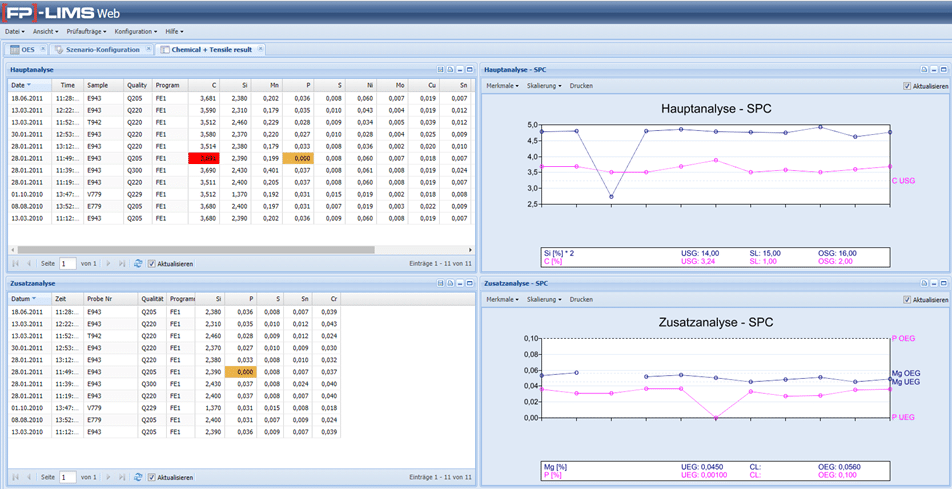
The true value of modern foundry IT comes from networking systems into a closed digital control loop. This process begins directly at the spectrometer (OES), from which measurement data is imported into the [FP]-LIMS laboratory information management system without any manual intermediate steps. Once the chemical analysis is created, an automatic comparison with the target specifications of the desired alloy takes place. If the melt does not yet meet the requirements, the status is set to “Not OK” and the values are exported directly to the FRP.melt add-on for the next step.
At this point, software-supported charge correction takes over. With direct access to the stored material database, the FRP.melt add-on calculates the exact addition quantities in real time to economically balance the difference to the target analysis. This calculated material list for the charge correction is then sent back to [FP]-LIMS so that the furnace operator immediately receives clear and error-free work instructions. Only when the subsequent control measurement by [FP]-LIMS confirms that all parameters have been reached and the status jumps to “OK” is the batch considered ready to pour. This comparison between theoretical planning and actual execution guarantees that every melt exactly meets the specification and that expensive faulty batches are a thing of the past.
![Charge Correction Graph - [FP]-LIMS and FRP.melt / frame](https://blog.fp-lims.com/wp-content/uploads/2026/03/Charge-Correction-Graph-FP-LIMS-and-FRP.melt-frame-.png)
What does modern charge correction mean?
Modern charge correction goes far beyond the mere addition of material as it is the result of a digital process chain. While in the past one often had to rely on the valuable but subjective gut feeling of experienced furnace operators, today’s charge correction is based on an exact actual analysis of the liquid melt. The foundation is formed by high-precision algorithms from specialized software such as FRP.melt. Taking into account the current furnace filling and the target specifications, it calculates the exact quantities of alloying elements and metals required for the perfect result.
The decisive advantage of this digital approach lies in error prevention. Due to mathematical accuracy, the number of necessary re-alloying steps can be massively reduced. In practice, this means that where three or four correction loops were previously necessary, modern charge correction often leads to success after the very first step. This not only significantly shortens the melting time but also ensures a stable and reproducible process from the initial sampling to the final casting. In this way, quality becomes predictable and the efficiency of the entire melting operation is raised to a new level.
Digitalization as a Key to Success
In the modern foundry industry, charge correction is far more than just a technical intermediate step as it represents one of the most effective levers for your economic competitiveness. While many plants already operate with high levels of automation in production, the digitalization of melting operations often still offers untapped potential for massive cost reductions.
Those who rely on digital precision instead of outdated Excel lists achieve immediately measurable results. Software-supported charge correction not only reduces material costs through exact calculations but also increases the quality of your end products through more stable processes. In times of rising energy prices and strict quality specifications, this precise control mechanism is indispensable for saving time, energy, and valuable raw materials.
Investing in intelligent charge correction does not only pay off on the balance sheet. It secures the long-term technological edge you need in global competition. Optimize your melting operations now and rely on accuracy instead of estimates.
Optimize your melting operations now and choose an intelligent solution for your charge correction.
![LIMS Lab - [FP]-LIMS helps you work even more efficiently](https://blog.fp-lims.com/wp-content/uploads/2026/01/LIMS-Lab-FP-LIMS-helps-you-work-even-more-efficiently-1024x1024-1160x665.png "LIMS Lab - [FP]-LIMS helps you work even more efficiently")
![Thanks to [FP]-LIMS, your LIMS lab will become even more efficient.](https://blog.fp-lims.com/wp-content/uploads/2026/01/Thanks-to-FP-LIMS-your-LIMS-lab-will-become-even-more-efficient.png)
![[FP]-LIMS Editions](https://blog.fp-lims.com/wp-content/uploads/2026/01/FP-LIMS-Editions.png)
![LIMS Lab - [FP]-LIMS Analysis Management.png](https://blog.fp-lims.com/wp-content/uploads/2026/01/LIMS-Lab-FP-LIMS-Analysis-Management.png.webp "LIMS Lab - [FP]-LIMS Analysis Management.png")
![LIMS Lab - [FP]-LIMS Inspection Order Management](https://blog.fp-lims.com/wp-content/uploads/2026/01/LIMS-Lab-FP-LIMS-Inspection-Order-Management.png)
![LIMS Lab - [FP]-LIMS ELN.png](https://blog.fp-lims.com/wp-content/uploads/2026/01/LIMS-Lab-FP-LIMS-ELN.png.webp "LIMS Lab - [FP]-LIMS ELN.png")
![LIMS Lab - [FP]-LIMS Production Dashboard](https://blog.fp-lims.com/wp-content/uploads/2026/01/LIMS-Lab-FP-LIMS-Production-Dashboard.png)
![LIMS Lab - [FP]-LIMS Recipe Management](https://blog.fp-lims.com/wp-content/uploads/2026/01/LIMS-Lab-FP-LIMS-Recipe-Management.png)


![Global LIMS – Why [FP]-LIMS is the perfect solution for internationally networked companies](https://blog.fp-lims.com/wp-content/uploads/2025/09/Global-LIMS-–-Why-FP-LIMS-is-the-perfect-solution-for-internationally-networked-companies-1024x1024-1160x665.png "Global LIMS – Why [FP]-LIMS is the perfect solution for internationally networked companies")
![Global LIMS – Why [FP]-LIMS is the perfect solution for internationally networked companies](https://blog.fp-lims.com/wp-content/uploads/2025/09/Global-LIMS-–-Why-FP-LIMS-is-the-perfect-solution-for-internationally-networked-companies-1024x1024-350x320.png "Global LIMS – Why [FP]-LIMS is the perfect solution for internationally networked companies")
![Flexible and customizable LIMS software at an affordable price - [FP]-LIMS](https://blog.fp-lims.com/wp-content/uploads/2025/01/Flexible-and-customizable-LIMS-software-at-an-affordable-price-FP-LIMS.png)

![Transaction data in LIMS - Flexibility and Application Diversity with [FP]-LIMS](https://blog.fp-lims.com/wp-content/uploads/2025/01/Transaction-data-in-LIMS-Flexibility-and-Application-Diversity-with-FP-LIMS-1-1024x1024-1160x665.png "Transaction data in LIMS - Flexibility and Application Diversity with [FP]-LIMS")
![Transaction data in LIMS - Flexibility and Application Diversity with [FP]-LIMS](https://blog.fp-lims.com/wp-content/uploads/2025/01/Transaction-data-in-LIMS-Flexibility-and-Application-Diversity-with-FP-LIMS-1-1024x1024-450x450.png "Transaction data in LIMS - Flexibility and Application Diversity with [FP]-LIMS")















![Michael Kramer - Fink & Partner -[FP]-LIMS](https://blog.fp-lims.com/wp-content/uploads/2023/12/michael_kramer_fink-partner_fp-lims-1-495x400-1.jpeg)
![Marleen Haack Fink & Partner - [FP]-LIMS](https://blog.fp-lims.com/wp-content/uploads/2023/12/marleen_haack_fink-partner_fp-lims-495x400-1.jpeg)
![[FP]-LIMS Interview Sales](https://blog.fp-lims.com/wp-content/uploads/2023/12/LOGO-TRANSPARENCY-e1644409793172-2048x420-2.png)

![Lab software [FP]-LIMS](https://blog.fp-lims.com/wp-content/uploads/2024/01/Lab-software-FP-LIMS.jpg)
![Fink & Partner - Interfaces - [FP]-LIMS](https://blog.fp-lims.com/wp-content/uploads/2024/01/Fink-Partner-Interfaces-FP-LIMS.jpg)